Home Yoga in Delhi: A Complete 5-Step Setup Guide for Beginners
Navigating life in a bustling metropolis like Delhi NCR comes with its own set of health challenges—long daily commutes, high stress levels, sedentary desk jobs, and seasonal air pollution. Because of these hurdles, sticking to a rigid studio schedule becomes difficult for most working professionals, homemakers, and senior citizens.
This is why practicing Home Yoga in Delhi has emerged as the most sustainable and practical wellness solution. When you practice in your own space, you save hours of travel time and build consistency effortlessly. However, to experience the true physical and mental benefits of yoga, simply rolling out a mat anywhere is not enough. Your surroundings directly impact your focus, breathing, and posture alignment.
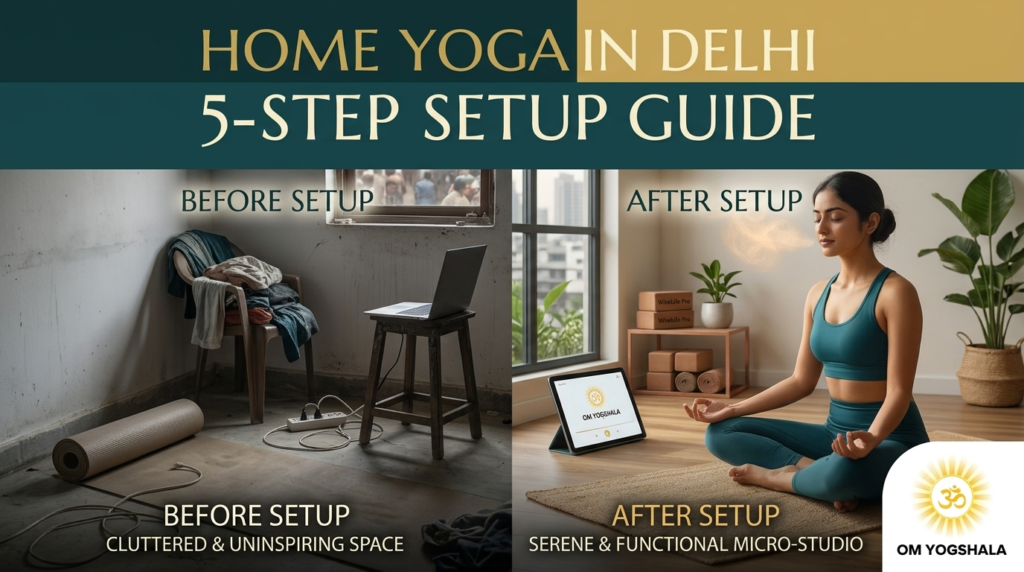
Here is a practical, 5-step checklist to transform any corner of your Delhi apartment or house into a serene, high-energy yoga sanctuary.
Step 1: Choose a Quiet, Well-Ventilated Corner
You do not need an entire empty room to practice yoga effectively. Even a compact 6×4 feet area in a Delhi flat is more than enough, provided you choose the spot wisely.
- Prioritize Natural Light & Airflow: Pick a spot near a window, balcony, or terrace where fresh morning sunlight enters. Morning sunlight boosts Vitamin D levels and naturally energizes your body.
- Check Delhi’s Air Quality (AQI): On days when outdoor pollution levels spike in Delhi NCR, avoid open balconies. Instead, practice indoors near an air purifier or indoor air-purifying plants like Snake Plant or Areca Palm.
- Minimize Household Traffic: Choose a corner away from the television, kitchen noise, or main hallway so your concentration remains unbroken for 45 to 60 minutes.
Step 2: Arrange Essential Yoga Props (Without Overspending)
Many beginners assume they need expensive fitness equipment before starting. In reality, a few basic, non-slip props are sufficient to protect your joints and improve flexibility safely.
Essential Prop | Primary Purpose | Beginner Alternative |
Non-Slip Yoga Mat (6mm) | Provides joint cushioning and prevents slipping on marble/tile floors | Thick cotton dhurrie (temporarily) |
2 Yoga Blocks | Helps reach the floor safely in standing/seated poses | Two thick, sturdy hardcover books |
Yoga Strap / Belt | Assists in deep hamstring and shoulder stretches | A standard cotton dupatta or long belt |
Firm Cushion / Bolster | Supports the spine during Pranayama and seated meditation | A folded thick blanket or firm sofa cushion |
If you are practicing targeted routines—such as posture correction, injury recovery, or yoga for weight loss—having these props handy allows you to hold postures longer without straining your lower back or knees.
Step 3: Keep Your Space Clean, Clutter-Free, and Temperature-Controlled
According to traditional yogic principles (Saucha or cleanliness), a cluttered physical environment creates mental distraction. Before stepping onto your mat, ensure your immediate surroundings are clean and safe.
- Dust-Free Flooring: Delhi’s dry weather brings fine dust indoors quickly. Wipe your yoga area daily so you don’t inhale dust particles during deep breathing exercises.
- Seasonal Temperature Adjustment:
- During Delhi Summers (April–July): Keep the room cool using ceiling fans or mild air conditioning (around 24–25°C) to prevent dehydration.
- During Delhi Winters (December–February): Cold marble floors can stiffen muscles and increase injury risk. Place a warm rug underneath your yoga mat and practice in a draft-free room.
- Clear Sharp Edges: Ensure coffee tables, chairs, or fragile decor are at least an arm’s length away so you can stretch freely during dynamic sequences like Surya Namaskar.
Step 4: Create a Calming Sensory Ambiance
Yoga is more than just physical exercise—it is a mind-body discipline designed to calm your nervous system. Subtle sensory cues signal your brain that it is time to slow down and disconnect from daily work pressure.
- Soft Lighting: Avoid harsh overhead white LED lights during evening sessions. Use warm lamps, natural daylight, or soft corner lighting.
- Subtle Aromatherapy: A mild camphor diffuser, sandalwood incense, or lavender essential oil helps deepen your breathing rhythm.
- Digital Detox: Keep your smartphone on silent mode and out of reach. According to public health guidelines from the World Health Organization (WHO), reducing screen interruptions during daily physical activity significantly improves mental focus and stress recovery.
If managing daily anxiety or burnout is your primary goal, pairing this calming ambiance with structured Meditation & Pranayama sessions can accelerate your mental relaxation.
Step 5: Build a Consistent Routine with Expert Guidance
The biggest challenge with home workouts is losing motivation after the first week. Turning your setup into a lifelong habit requires structure and professional accountability.
- Fix Your Time Slot: Morning sessions (between 6:30 AM and 9:00 AM) work best on an empty stomach to boost metabolism, while evening sessions (6:00 PM to 8:00 PM) help release accumulated work stress.
- Start with 30–45 Minutes: Consistency beats intensity. Practicing 4 to 5 days a week yields far better results than one exhausting weekend session.
- Get Personalized Supervision: Practicing complex postures by watching random videos often leads to incorrect alignment. Working one-on-one with a Personal Yoga Trainer in Delhi ensures every asana is adapted to your body type, flexibility level, and medical history.
Frequently Asked Questions (FAQs)
- How much space do I need for home yoga in a Delhi apartment? A clear rectangular space of roughly 6 feet by 4 feet is completely sufficient for a standard yoga mat and full arm/leg extensions.
- Is home yoga effective for beginners with back pain or stiff joints? Yes. In fact, home yoga is safer for beginners because a certified instructor can customize every posture using pillows, chairs, or blocks to protect your spine and joints.
- What is the best time to do yoga at home in Delhi? Early morning on an empty stomach is ideal for energy and digestion. However, if you have a busy morning schedule, an evening session (at least 3 hours after lunch) is equally effective for stress relief.
- Do I need to buy yoga props before my first class? No. For your first session, you only need a comfortable yoga mat and breathable clothing. Your instructor will guide you on which props—if any—are needed based on your body’s flexibility.
Start Your Home Yoga Journey with Om Yogshala
Setting up your space is the first step toward a healthier, stress-free lifestyle. Whether you live in South Delhi, Dwarka, Rohini, Noida, or Gurugram, Om Yogshala brings certified, background-verified yoga instructors right to your doorstep—or connects you virtually via interactive Online Yoga Classes.
Ready to experience personalized wellness in the comfort of your home? Contact Om Yogshala today to book your first customized session!