
Yoga for Office Workers: 15-Minute Desk Routine (Omyogshala)
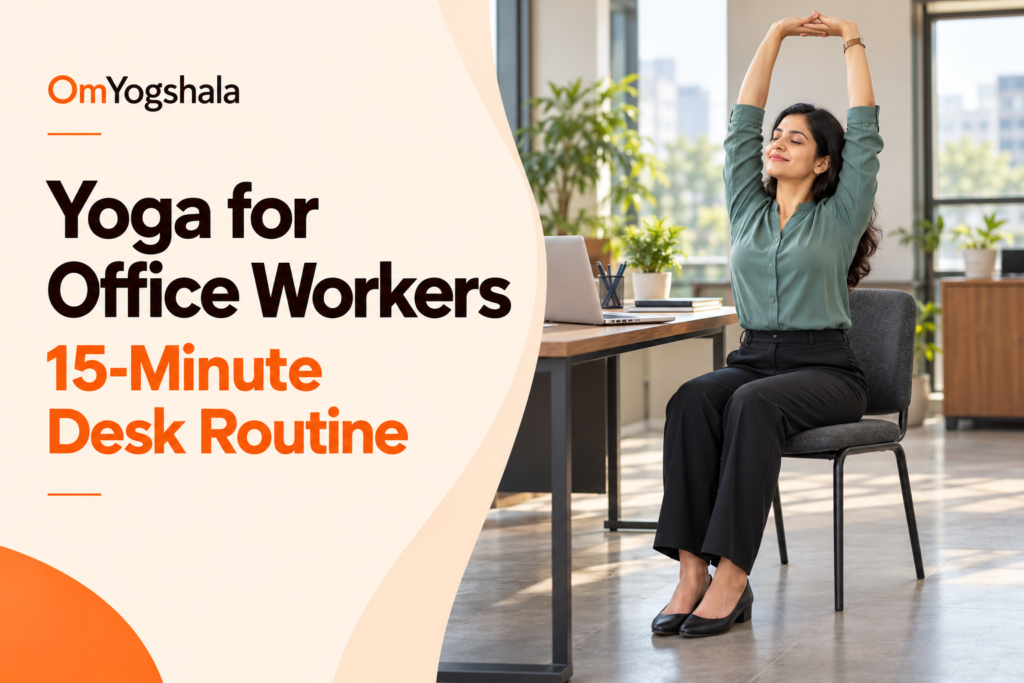
For many professionals in Cyber City, Gurugram, a normal day means a traffic-heavy commute, a laptop, and eight or nine hours of meetings, emails and deadlines. By evening, the body has barely moved.
The issue is often not the workload itself but how long we stay in one position. Hours of screen time can leave the neck, shoulders, lower back and hips feeling stiff, and you can feel tired even though you have only been sitting.
You do not need a studio or a full hour. This guide gives you a beginner-friendly 15-minute yoga routine for office workers that uses a chair, a wall and a little floor space. It works for desk-bound roles of all kinds, including yoga for IT professionals who spend long stretches coding, in calls or reviewing screens.
In short: a 15-minute routine of seated and standing stretches, done once a day and combined with short movement breaks, is a practical way to add movement to a sedentary workday. It supports comfort and mobility; it does not replace medical care.
Why Do Office Workers Need Yoga?
Sitting for long periods often goes with leaning towards the screen, a forward head position and raised shoulders while typing. Over time these habits can add to everyday muscle tension and stiffness.
The World Health Organization recommends that adults aged 18 to 64 aim for 150 to 300 minutes of moderate-intensity aerobic activity a week, plus muscle-strengthening activities on two or more days. It also stresses that some activity is better than none, which is why short daily sessions are a useful start for anyone with a sedentary lifestyle.
Here is what a short routine can offer:
- Neck and shoulder relaxation: gentle movement for areas that stay still during desk work.
- Better mobility: stretching can help the hips, back and shoulders move more comfortably.
- Posture awareness: yoga trains you to notice how you sit and breathe.
- A mental reset: slow breathing gives your mind a pause between demanding tasks.
- Less unbroken sitting: a scheduled break makes it easier to get up regularly.
Yoga is not a treatment for medical conditions and cannot guarantee freedom from work-related pain. It is one useful part of a balanced routine.
Your 15-Minute Desk Yoga Routine
These desk yoga exercises need no equipment: a stable chair, a wall and about a metre of clear floor. Move slowly, breathe steadily and stay within a comfortable range. Total time: 15 minutes.
Step | Movement | Time |
1 | Deep breathing and posture reset | 1 min |
2 | Neck and shoulder release | 1.5 min |
3 | Wrist and finger stretch | 1 min |
4 | Seated Cat-Cow | 2 min |
5 | Seated spinal twist | 2 min |
6 | Standing side stretch and chest opener | 2 min |
7 | Standing forward fold | 2 min |
8 | Low lunge for hip flexors | 2 min |
9 | Wall Downward Dog | 1 min |
10 | Final breathing and relaxation | 30 sec |
1. Deep Breathing and Posture Reset (1 Minute)
- Sit with both feet flat on the floor and your back naturally upright.
- Relax your shoulders and rest your hands on your thighs.
- Inhale slowly through your nose, then exhale without forcing the breath.
- Continue for one minute.
This pause helps you notice your breathing and prepares you for the movements ahead.
2. Neck and Shoulder Release (1.5 Minutes)
- Slowly turn your head to the right, return to the centre, then repeat to the left.
- Gently tilt your ear towards each shoulder without forcing the stretch.
- Roll your shoulders backwards, then forwards.
- Keep every movement slow and controlled.
Avoid fast neck circles and do not pull your head with your hands.
3. Wrist and Finger Stretch (1 Minute)
- Extend one arm in front of you with the palm facing away.
- Use your other hand to gently support the wrist and fingers back. Do not pull hard.
- Repeat on the other side.
- Finish by opening and closing your fingers several times.
Typing, mouse use and phone scrolling keep your hands busy all day, so they deserve a break too.
4. Seated Cat-Cow (2 Minutes)
- Sit towards the front of the chair with your hands on your knees.
- Inhale, gently lift your chest and look slightly forward.
- Exhale, round your upper back and bring your chin slightly towards your chest.
- Repeat slowly, following your breath, without forcing your back.
This is a simple way to add gentle spinal movement, which many people find helpful for back stiffness from long sitting.
5. Seated Spinal Twist (2 Minutes)
- Sit upright with your feet on the floor.
- Place your right hand on your left thigh and turn your upper body gently to the left.
- Keep your hips facing forward and breathe comfortably.
- Return to the centre and repeat on the other side, about one minute per side.
6. Standing Side Stretch and Chest Opener (2 Minutes)
- Stand beside your desk with enough space around you.
- Raise one arm overhead and lean gently to the opposite side, keeping both feet firmly planted. Repeat on the other side.
- If comfortable, clasp your hands behind your back and gently open your chest.
These movements counter the rounded posture common when working on a laptop.
7. Standing Forward Fold (2 Minutes)
- Stand with your feet about hip-width apart and bend your knees slightly.
- Fold forward slowly from the hips and let your arms hang.
- Keep your knees softly bent, then rise slowly.
Do not try to touch your toes. If you have high blood pressure, dizziness or an eye condition, check with your doctor first and keep your head above heart level.
8. Low Lunge for Hip Flexors (2 Minutes)
- Step one foot forward and lower the opposite knee towards the floor, using a folded mat or soft surface if needed.
- Keep your upper body upright and move your hips forward slightly until you feel a comfortable stretch.
- Switch sides after one minute.
Use a chair or wall for balance. If your knees are sensitive, skip this step and repeat the standing side stretch instead.
9. Wall Downward Dog (1 Minute)
- Place your hands on a stable wall at about shoulder height.
- Walk your feet back, keeping them firmly on the floor.
- Move your hips backwards and let your upper body lengthen, with relaxed shoulders.
This is a practical alternative to getting down on a mat during office hours.
10. Final Breathing and Relaxation (30 Seconds)
Stand or sit comfortably, close your eyes if that feels right, and take a few slow breaths. Notice how your body feels before you return to work.
How to Fit Yoga Into a Busy Office Schedule
Instead of waiting for a free hour, attach yoga to something already in your day:
- Before work: five minutes of gentle stretching to prepare the body.
- At lunch: a short walk followed by a few seated stretches.
- After long meetings: stand up and do steps 2, 4 and 5 before returning to your desk.
- After office hours: the full 15-minute routine.
Breaks matter as much as the routine itself. OSHA’s Computer Workstations eTool advises arranging computer work so people can vary tasks, change posture and take short micro-breaks or recovery pauses. It does not set one fixed interval. A simple habit that fits this advice: stand, stretch or walk for a minute or two at least once an hour, and look away from the screen regularly.
Common Mistakes to Avoid
- Stretching aggressively to gain flexibility quickly.
- Holding your breath during harder movements.
- Ignoring discomfort to finish every pose.
- Practising without enough space or on an unstable chair.
- Expecting 15 minutes of yoga to offset an otherwise inactive lifestyle.
Stop if you feel pain, dizziness or unusual discomfort. If you have an injury, a medical condition or movement restrictions, speak to a doctor or qualified professional before you start.
Is 15 Minutes of Yoga Enough for Office Workers?
It is an excellent starting point, especially if finding time for exercise is your main hurdle. But it is one part of a healthy week, not the whole of it. Combine it with:
- regular walking,
- strength-building work (see our guide to yoga for strength),
- a comfortable workstation set-up,
- consistent sleep and hydration.
The WHO activity targets above can help you plan the rest of your week.
Yoga for Offices in Cyber City and Gurugram
If you manage a team, a single desk-yoga video rarely turns into a habit. Guided sessions at the workplace usually work better because they are scheduled and led by someone who can correct posture.
Omyogshala offers corporate yoga classes with desk and chair yoga, breathing practices and stress-relief sessions, either on-site or live online. Details for local teams are on our corporate yoga classes in Gurgaon page. Individuals who prefer one-to-one guidance can look at yoga classes in Gurgaon or online yoga classes. If work stress is your main concern, see yoga for stress relief.
Yes. Seated Cat-Cow, shoulder and neck release, wrist stretches and seated twists can all be done on a stable office chair.
Yes, it is a manageable starting point. Increase gradually as your comfort and fitness allow
Gentle mobility work may ease the feeling of stiffness from staying in one position. Persistent or severe back pain should be assessed by a qualified healthcare professional.
Final Thoughts
Long hours and tight deadlines make it easy to push your own wellbeing to the bottom of the list. A 15-minute routine is a simple way to bring movement, breathing and a little calm into the workday. Start gently, take regular breaks and build a habit that fits your schedule.