Yoga And Meditation Difference: Understand the Right Path to Holistic Wellness
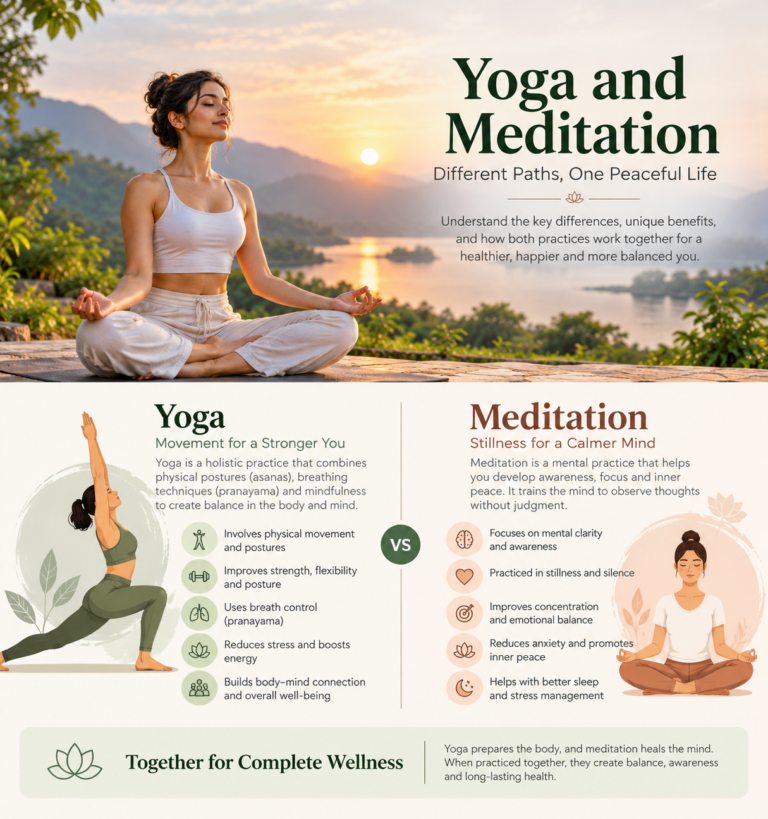
Have you ever wondered whether yoga and meditation are the same? You're not alone. Many people use these terms together, but each practice has its own role in keeping the body and mind healthy.
The main difference between yoga and meditation is how they are practiced. Yoga is a broad practice that includes physical poses, breathing, and mental focus. Meditation trains your attention and helps you become more aware of your thoughts.
Both have roots in ancient Indian traditions. Both can help you feel calm, manage stress, and build healthy habits.
But should you choose yoga or meditation? Or can you enjoy the benefits of both?
In this guide, we'll explore yoga vs meditation, their key differences, benefits, and simple ways to add them to your daily life.
What Is Yoga?
Yoga is an ancient Indian practice that connects the body, breath, and mind. The word "yoga" comes from the Sanskrit root yuj, which means "to join" or "to unite."
Many people think yoga is only about stretching or doing poses. But yoga is much more than a physical workout.
It is a broad system that includes movement, breathing, focus, and self-awareness.
What Does Yoga Include?
A yoga practice may include:
- Asanas (yoga poses): Help build strength, flexibility, and balance.
- Pranayama: Breathing practices that help you become more aware of your breath.
- Dhyana: Meditation that develops attention and mental awareness.
- Relaxation: Gives the body and mind time to rest.
- Mindful living: Encourages awareness in daily life.
For example, when you practice Surya Namaskar (Sun Salutation), you move through a series of poses while paying attention to your breath.
This can help you feel more active, focused, and relaxed.
Yoga is a good choice if you want to improve physical fitness while caring for your mental well-being. Beginners who prefer personal guidance can explore Omyogshala's personalized yoga classes to learn more about available options.
What Is Meditation?
Meditation is a practice that helps you train your attention and become more aware of the present moment.
It often involves sitting in a quiet place, focusing on your breath, or noticing your thoughts without judging them.
The goal is not to stop thinking. Instead, meditation teaches you to notice your thoughts and gently bring your attention back when your mind wanders.
You do not need special tools or a large space to meditate. Even a few minutes of daily practice can be a useful start.
How Does Meditation Work?
Imagine sitting quietly for five minutes.
You close your eyes, relax your shoulders, and focus on your breathing.
After a while, your mind starts thinking about work, family, or tomorrow's plans.
That's normal.
Instead of getting upset, you simply notice the thought and return your focus to your breath.
This simple process helps you practice attention and awareness.
Over time, regular meditation may help you manage stress, improve focus, and respond to daily challenges with more calm.
Yoga vs Meditation: 7 Key Differences
Although yoga and meditation share many benefits, they are not exactly the same.
The table below explains the difference between yoga and meditation in simple terms.
| Aspect | Yoga | Meditation |
|---|---|---|
| Main Focus | Body, breath, and mind | Attention and awareness |
| Physical Activity | Often includes poses and movement | Usually involves little movement |
| Main Goal | Support physical and mental well-being | Develop focus, awareness, and calm |
| Common Methods | Asanas, pranayama, relaxation | Breath awareness, mindfulness, mantra |
| Physical Benefits | Builds flexibility, strength, and balance | May help the body relax |
| Mental Benefits | Can reduce stress and improve mood | Can support focus and emotional balance |
| Best Suited For | Movement and relaxation | Stillness and mental focus |
1. Yoga Often Uses Movement, While Meditation Focuses on Attention
Most modern yoga classes involve physical poses and controlled breathing.
Meditation usually involves sitting, walking, or resting while paying attention to the present moment.
2. Yoga Can Build Physical Strength
Yoga poses can help improve muscle strength, balance, and flexibility.
Meditation does not aim to build physical strength. Its main focus is mental training.
3. Meditation Places More Attention on the Mind
Both practices involve awareness. However, meditation places greater focus on how you observe thoughts, feelings, and sensations.
4. Yoga May Need More Space
For a movement-based yoga session, a mat and enough room to stretch can be helpful.
Meditation can be practiced almost anywhere, including a quiet room or a comfortable chair.
5. Yoga and Meditation Have Different Practice Styles
A yoga class may include warm-ups, poses, breathing exercises, and relaxation.
A meditation session may involve watching your breath, repeating a mantra, or practicing mindfulness.
6. Both Can Help Manage Stress
Yoga combines movement and breathing, which may help ease physical tension.
Meditation helps you notice your thoughts and respond to stress with greater awareness.
7. Both Can Be Part of One Routine
You don't need to choose only one.
A short yoga session followed by meditation can be a simple way to care for your body and mind.
Is Yoga and Meditation the Same?
No, yoga and meditation are not the same, but they are closely connected.
Yoga is a broad practice that includes physical, mental, and traditional spiritual elements. Meditation is one part of many yoga traditions, though it is also practiced outside yoga.
Think of yoga as a complete set of tools for the body and mind. Meditation is one of those tools.
You can practice yoga without doing a long meditation session. You can also meditate without practicing yoga poses.
Both approaches are valid.
Is Yoga a Form of Meditation?
Some types of yoga can feel meditative, especially when you move slowly and focus on your breath.
However, not every yoga session is meditation.
In traditional yoga, meditation is an important part of the wider practice.
This is why yoga and meditation are often taught together.
If you want to explore poses that encourage calm and awareness, read our guide to meditative asanas for a calm mind.
Benefits of Yoga and Meditation
Both practices can support a healthier lifestyle. Their benefits often overlap, but each has its own strengths.
Physical Benefits of Yoga
Regular yoga practice may help you:
- Improve flexibility and joint mobility.
- Build muscle strength.
- Develop better balance.
- Support healthy posture.
- Reduce everyday muscle tension.
- Feel more comfortable during daily movement.
You don't need to be flexible to begin yoga.
Start with gentle poses and move at your own pace. As you practice, your body may become stronger and more comfortable with movement.
Mental Benefits of Meditation
Regular meditation may help you:
- Manage everyday stress.
- Improve attention and focus.
- Become more aware of your emotions.
- Feel calmer during busy days.
- Support better sleep.
- Develop a more mindful response to challenges.
These changes take practice. Some people notice small benefits early, while others need more time.
There is no fixed timeline, and results differ from person to person.
Shared Benefits of Yoga and Meditation
Yoga and meditation may both help you feel less stressed and more aware of your body and mind.
They can also give you a healthy break from screens, work, and daily worries.
Neither practice is a cure for medical conditions, but both can be useful parts of a balanced wellness routine.
Yoga or Meditation: Which Is Better for You?
The answer depends on your needs.
If you enjoy movement and want to improve physical fitness, yoga may be a better place to start.
If you want to train your attention or spend more time in quiet reflection, meditation may suit you.
Let's look at a few common goals.
For Stress Relief
Both yoga and meditation can help with stress.
Yoga may be helpful when stress leaves your muscles feeling tight or your body restless.
Meditation may be helpful when your thoughts feel busy and you want to practice staying present.
Best choice: Try both and see which feels more comfortable.
For Physical Fitness
Yoga is the better choice if your main goal is to improve flexibility, balance, or strength.
Movement-based yoga gives your body a gentle workout while encouraging mindful breathing.
Best choice: Yoga.
For Focus and Inner Peace
Meditation is a good option when you want to develop attention, awareness, and emotional balance.
You can begin with a short breath-focused practice and build your routine over time.
Best choice: Meditation.
For Overall Well-Being
If you want both movement and mental relaxation, you can combine yoga and meditation.
A balanced routine allows you to enjoy the unique benefits of each practice.
Best choice: Yoga and meditation together.
How to Practice Yoga and Meditation Together
You don't need to spend hours each day to get started.
A simple 20-minute routine can help you build a habit.
A Beginner-Friendly 20-Minute Routine
Step 1: Gentle Yoga — 5 Minutes
Begin with easy stretches, neck movements, and Cat-Cow Pose.
Move slowly and avoid forcing your body into any position.
Step 2: Basic Yoga Poses — 7 Minutes
Try a few simple poses:
- Tadasana (Mountain Pose)
- Balasana (Child's Pose)
- Sukhasana (Easy Pose)
Choose poses that feel safe and comfortable for your body.
Step 3: Calm Breathing — 3 Minutes
Sit comfortably and pay attention to your natural breath.
Breathe gently without holding or forcing it.
Step 4: Meditation — 5 Minutes
Close your eyes if comfortable, or lower your gaze.
Notice your breath as it moves in and out.
When your mind wanders, gently return your attention to breathing.
That's it! This short routine is a practical way to begin. You can increase the time as your comfort and interest grow.
If you have an injury or health condition, speak with a qualified professional before trying new poses.
Difference Between Yoga and Meditation in Hindi
योग और ध्यान में क्या अंतर है?
योग और ध्यान दोनों ही भारतीय परंपरा का महत्वपूर्ण हिस्सा हैं। ये शरीर और मन को स्वस्थ रखने में मदद कर सकते हैं, लेकिन दोनों के अभ्यास का तरीका अलग है।
योग (Yoga): योग में आसन, प्राणायाम, ध्यान और शरीर व मन के बीच संतुलन पर ध्यान दिया जाता है। नियमित योग अभ्यास से शरीर की ताकत, लचीलापन और संतुलन बेहतर हो सकता है।
ध्यान (Meditation): ध्यान में मन को वर्तमान क्षण पर केंद्रित करने का अभ्यास किया जाता है। इससे एकाग्रता, आत्म-जागरूकता और मानसिक शांति बढ़ाने में मदद मिल सकती है।
मुख्य अंतर: योग एक व्यापक अभ्यास है, जिसमें शारीरिक आसन और ध्यान दोनों शामिल हो सकते हैं। ध्यान मुख्य रूप से मन की जागरूकता और एकाग्रता से जुड़ा अभ्यास है।
आप अपनी जरूरत के अनुसार योग, ध्यान या दोनों को अपनी दिनचर्या में शामिल कर सकते हैं।
Final Thoughts: Finding Your Balance with Omyogshala
The difference between yoga and meditation is simple. Yoga offers a broad approach to well-being through movement, breathing, and awareness. Meditation helps you train your attention and develop a calmer relationship with your thoughts.
You don't have to choose one over the other.
If you want to feel stronger and more flexible, begin with yoga. If you want to improve focus and mindfulness, try meditation. And if you want a balanced routine, make time for both.
At Omyogshala, we believe wellness begins with small, mindful steps.
Explore our yoga and meditation guidance and take your first step toward a healthier body, a calmer mind, and a more balanced life.
START YOUR WELLNESS JOURNEY TODAY
Find Your Balance with Omyogshala
Ready to bring more movement, mindfulness, and calm into your daily life? Explore personalized yoga guidance with Omyogshala and build a routine that suits your goals and lifestyle.
Explore Yoga ClassesFrequently Asked Questions About Yoga and Meditation
Find simple answers to common questions about yoga, meditation, and choosing the right practice.
1. What is the main difference between yoga and meditation?
2. Is yoga and meditation the same?
3. Which is better, yoga or meditation?
4. Is yoga a form of meditation?
5. Can I practice yoga and meditation together?
6. Should beginners start with yoga or meditation?
7. What happens after 40 days of meditation?
8. How long should I practice yoga and meditation daily?
Bring Balance to Your Body and Peace to Your Mind
Discover personalized yoga and meditation sessions with Omyogshala. Practice at your own pace with guidance suited to your experience, goals, and daily routine.